
Metadata: How structured tagging transforms content into AI-ready context
You’ve heard “metadata” mentioned increasingly in discussions about AI readiness, unified portals, and omnichannel content delivery. But most explanations either oversimplify it as “data about data” or bury it in technical jargon.
Metadata is the information layer that makes content findable, understandable, and actionable across systems, channels, and contexts.
It tells systems (and people) the 5 Whys of content and data, meaning
- what something is
- who it’s for
- how it relates to other things, and
- when and where it should be used.
If content is the words and images of a textbook, metadata is the table of contents, index, labels, and cross-references that make the textbook usable.
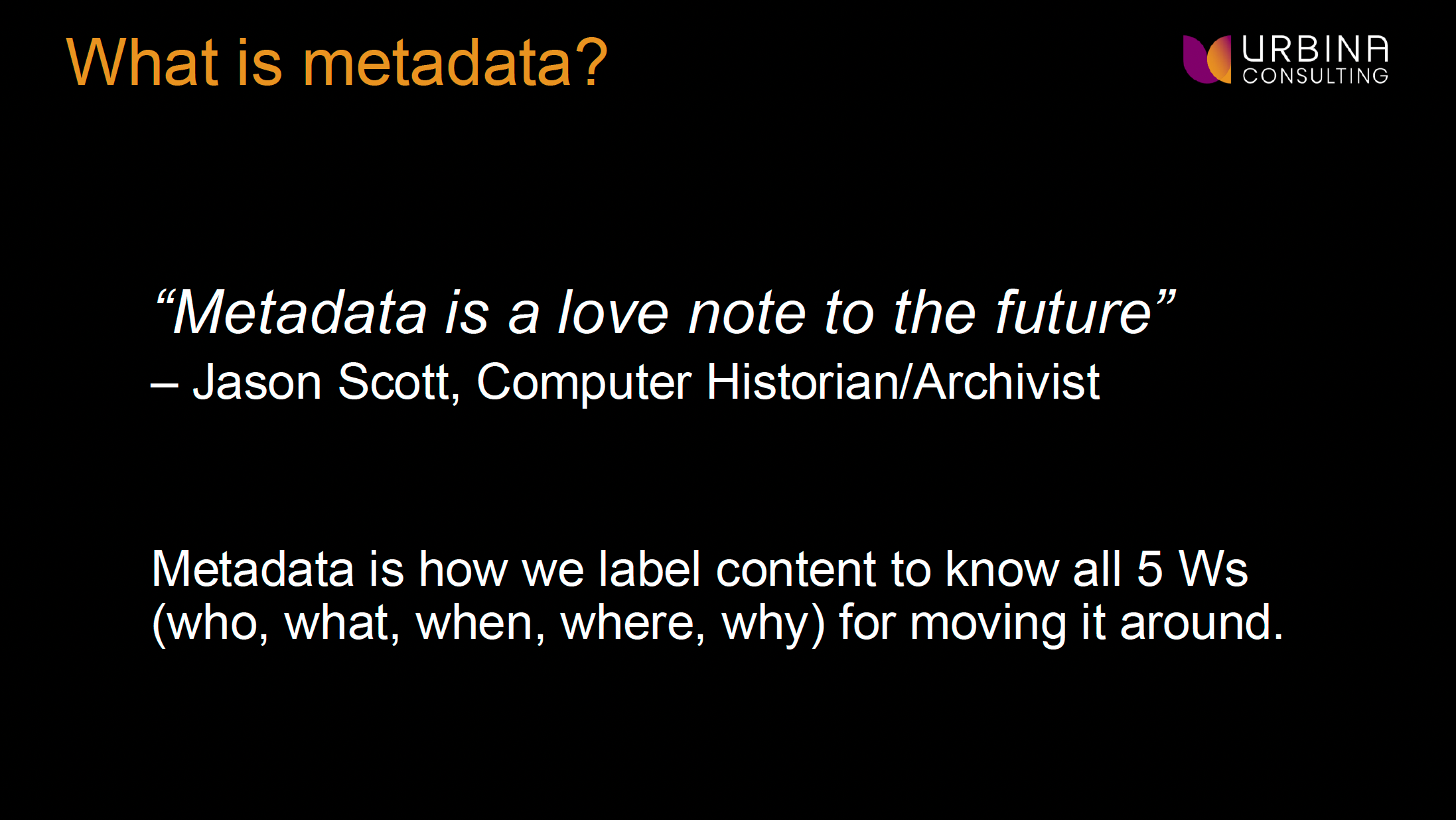
As Jason Scott, Computer Historian and Archivist, puts it: “Metadata is a love note to the future.”
It’s how today’s content decisions enable tomorrow’s capabilities; whether that’s helping a worker find what they need or powering AI systems and agents that need to reason over your business context.
Why metadata suddenly matters so much
Enterprise organisations face an impossible challenge:
-
Content volumes are exploding
-
Systems are fragmented
-
Customers expect personalisation
-
AI requires structured input
-
Teams need answers instantly
Without structured metadata, content becomes a liability rather than an asset.
In our project experience at Urbina Consulting, we’ve seen users forced to check 17+ different repositories to find answers to their needs, often with customers waiting or costs ticking up. As content volumes grow and user expectations rise this is unsustainable.
The organisations succeeding today treat metadata as infrastructure, not an afterthought. They understand that the question isn’t whether to invest in metadata, but how they can implement it effectively.
Metadata in action: A real-world scenario
To understand metadata’s transformative impact, let’s imagine Frank, a technician heading to repair a commercial boiler system. His needs reflect those we’ve seen in many workers from pharmaceuticals to enterprise software who need to access or share complex information, or answer complex questions.

His success depends on accessing the right information quickly, for his situation. Things like
- equipment specifications
- service history
- troubleshooting procedures, or
- safety protocols.
Each of these could be general for a product, or
- specific to a customer
- specific to a customer installation or configuration
- specific to equipment types, models, and versions
- specific to a geography, or
- specific to his role, certification, and access level.
Without metadata: The current reality
Frank opens countless documents, searches through files and databases, and potentially misses critical information.
Often different repository use different naming conventions, structures, and tagging systems and have different levels of effectiveness in their search capabilities.
What should take minutes can becomes hours of detective work.
With metadata: The intelligent solution
When Frank searches “boiler diagnostics commercial office Atlanta,” it’s metadata that will make or break whether he finds content for his unique situation.
Concepts like these are all anchors for which lists of metadata values (taxonomies) which can be applied to content and data:
- Product (boiler)
- Market (commercial offices)
- Region (Atlanta)
- Content type, task type (diagnostics).
From all of the mass of possibilities, metadata allows the underlying content to filter and adapt based on context and delivery requirements. We could deliver Frank,
- detailed technical specifications to support his preparation before he leaves the office
- mobile-optimised checklists for on-site
- the specific documentation for the specific situation, or
- voice-guided instructions through his headset.
What metadata actually does
6 strategic applications of metadata
Metadata is the connective tissue of your enterprise content ecosystem. Here’s what it enables.
1. System integration and interoperability
Modern enterprises run dozens of systems: CMS, CRM, configuration databases, analytics platforms, service systems.
Metadata provides a shared semantic layer so these systems can “speak the same language.”
Interoperable isn’t the same as “the same”. For decades, enterprises were trying to address findability and integration issues by having the “one database to rule them all”. They confused having a “single source of truth” with having a single system of record (official and only place that content or data is editted) with piling everything into one big data source. Getting everyone in a business to agree how to structure and label content and data is already nearly impossible, to say nothing of getting everyone to actually work in one system instead of the different specialised applications their parts of the business need.
Instead of trying create one giant source, interoperability means that different sources can exchange information and be able to operate on it effectively for their different needs.
For example, when Frank’s mobile device syncs with diagnostics software, metadata ensures the correct documentation loads automatically based on model and configuration. The metadata is the packaging that enables the successful exchange.
Without metadata, integration is fragile. With metadata, it’s scalable.
In Frank’s case, even with the right official documentation at hand, reality can throw curveballs, and he might need support.

2. Omnichannel personalised content delivery
One source. Multiple outputs. All coordinated to make an overall experience across channels that makes sense and is additive, where channels contribute their unique abilities to a end result greater than any of them could have delivered individually. That’s been a goal for brands for decades.
Metadata drives intelligent content adaptation across formats and channels. The same boiler troubleshooting information becomes:
-
A detailed PDF
-
A mobile checklist
-
A web article
-
An API response
-
Voice assistant instructions.
Something like a checklist is a view across multiple tasks and pulls out “What do I need to take with me” vs “What do I need to check is working before I leave the client site?”
Even in the age of AI and AI documentation, this type of machine understanding of the content is greatly enhanced with structured tagging and content modelling. If a human might struggle to do a task because things aren’t quite consistent or labelled clearly, an AI definitely will. As well, generative AIs like ChatGPT, Gemini, Claude, etc work with probabilities. They need the absolute clarity of metadata to ensure they’re reliable.
Even with the best content and systems, humans still have to help each other.

3. Intelligent search and discovery
Beyond keyword matching, metadata enables what’s called semantic search. Users find relevant content whether they search for “high limit safety switch” or “pressure spikes” because these concepts related conceptually. Just like a doctor might say “runny nose”, “nasal congestion”, or “rhinitis”, and a system should understand they’re all related to the respiratory system, there are almost never single correct terms that we can expect users to enter into search queries, so systems must be able to understand how concepts relate to each other.
Even if the words differ, the concepts are linked. And this dramatically improves
-
internal enterprise search
-
customer-facing portals
-
web discoverability, and
-
AI documentation generated answers.
In Frank’s story, he’s done some searching, he’s got the appropriate documentation, but the issue isn’t solved. So his colleague, Sally, who has different domain knowledge and can support him in the field by taking time to search knowledge base articles created by senior engineers that aren’t part of standard procedures and documentation.
4. Personalisation at enterprise scale
Different users often access different views of the same content based on role, experience, and context from both inside and outside the enterprise’s network.
↪ Frank sees technical specifications whilst
↪ Sally from customer support sees knowledge articles and escalation procedures that might be beyond Frank’s certification level.
↪ A customer might see a different view again
Metadata enables content and presentation to dynamically adapt to parameters like
-
role
-
context
-
device
-
location
-
product variant, or
- other specifics for an industry or domain.
5. Navigation and content relationships
Metadata powers the menus, filters, and “related content” features that help users navigate complex information architectures in parallel to search. It’s what makes large content ecosystems feel intuitive rather than overwhelming.
For example for Sally helping Frank, she might follow a series of tagged types of information to get to his answer:
Model → Symptom → Issue Type → Knowledge Article → Recommended Action.
Without structured metadata, navigation becomes manual and brittle.
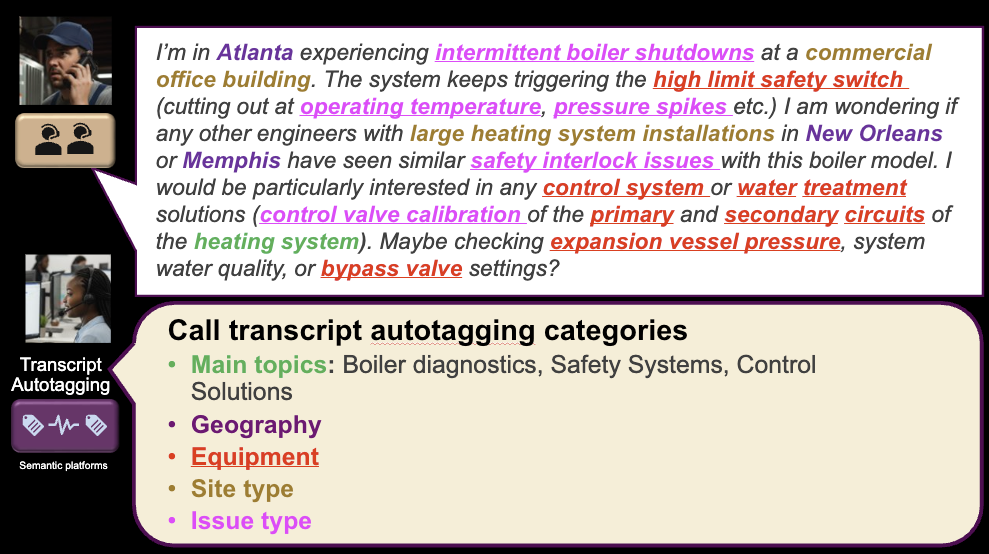
By now you might be wondering, how can we add all these tags to build these relationships? Enter autotagging.
Similar to automatic translation, autotagging of content has gone from very ineffective over a decade ago, to very useful even in demanding enterprise environments.
For example, today, even in real-time, Sally could have a metadata tagging extraction of Frank’s concerns, allowing her to navigate and search using specific tags pulled from the dialogue. These could be matched up with tags that either autotagging algorithms, humans, or a mix, could have added to the content itself.
6. AI documentation enhancements through RAG
AI documentation capabilities are greatly enhanced by metadata. Retrieval-Augmented Generation (RAG) systems rely on metadata to provide accurate, contextual responses. Well-structured metadata is what transforms AI from producing plausible-sounding, hopefully correct, content (sometimes nonsense) to delivering reliable, actionable guidance.
Research shows that improving data quality and structure yields exponentially greater performance improvements than simply tuning AI models.
In enterprise environments:
-
Knowledge graphs outperform traditional database (SQL) structures
-
Contextual tagging improves AI answer accuracy
-
Structured provenance improves explainability
Metadata essentially “doses” AI with the right facts, at the right time, in the right context.
At Urbina Consulting, we increasingly see metadata architecture as the defining factor in AI success.
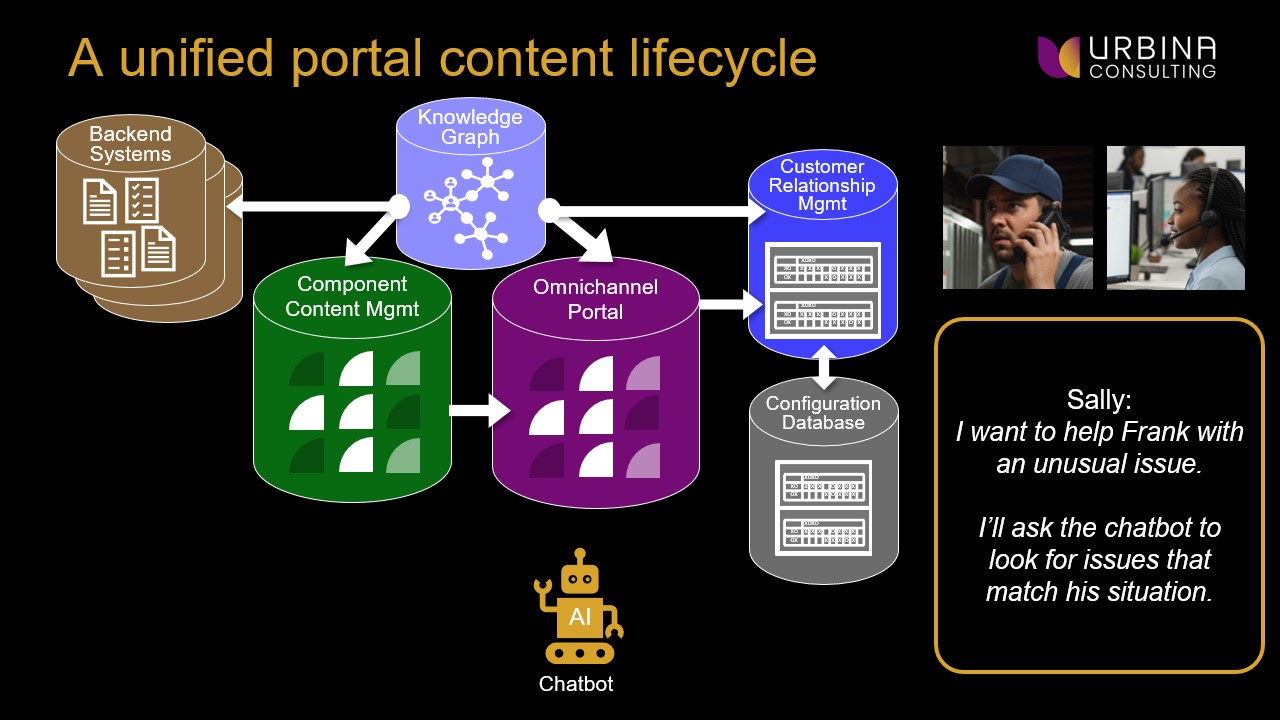
In Frank and Sally’s case, Sally can ask the chatbot for answers based on Frank’s query. It will organise its search based on the metadata tags extracted from the conversation, and further guidance from Sally’s domain experitise.

The strategic imperative
Metadata isn’t a technical nice-to-have but a business infrastructure for content-dependent organisations. Whether you’re supporting knowledge workers, field technicians, enabling customer self-service, or preparing for AI integration, metadata determines success.
As Arthur Mensch, CEO of Mistral AI, notes: “Content quality is the next frontier of AI performance improvement.” That quality starts with metadata architecture that treats content as a strategic asset rather than accumulated overhead.
The organisations investing in metadata today are building tomorrow’s competitive advantages. The question isn’t whether metadata matters but whether you’re building it strategically or leaving it to chance.
Contact us to discuss.
0 Comments