
About the ucLoops for Design method
An easy-to-learn AI framework and methodology that supports product, strategic, or content design work, usable in any major AI tool
The research challenge
User research, content, and experience design face a persistent dilemma: comprehensive user research and journey mapping are essential for good design, but they’re expensive and labour-intensive, and usually only available through UX research specialists. But audience or user understanding is something needed frequently, and all over an organisation.
Furthermore, creating thorough personas and user journey maps can take months, requiring extensive interviews, data analysis, and synthesis. The result is that many projects either skip proper user research entirely or rely on outdated insights that don’t reflect current user needs.
On the other hand, large enterprises can create so much research and so many personas and journey maps, that no one in the organisation can say they have a comprehensive view of consolidated, up-to-date insights.
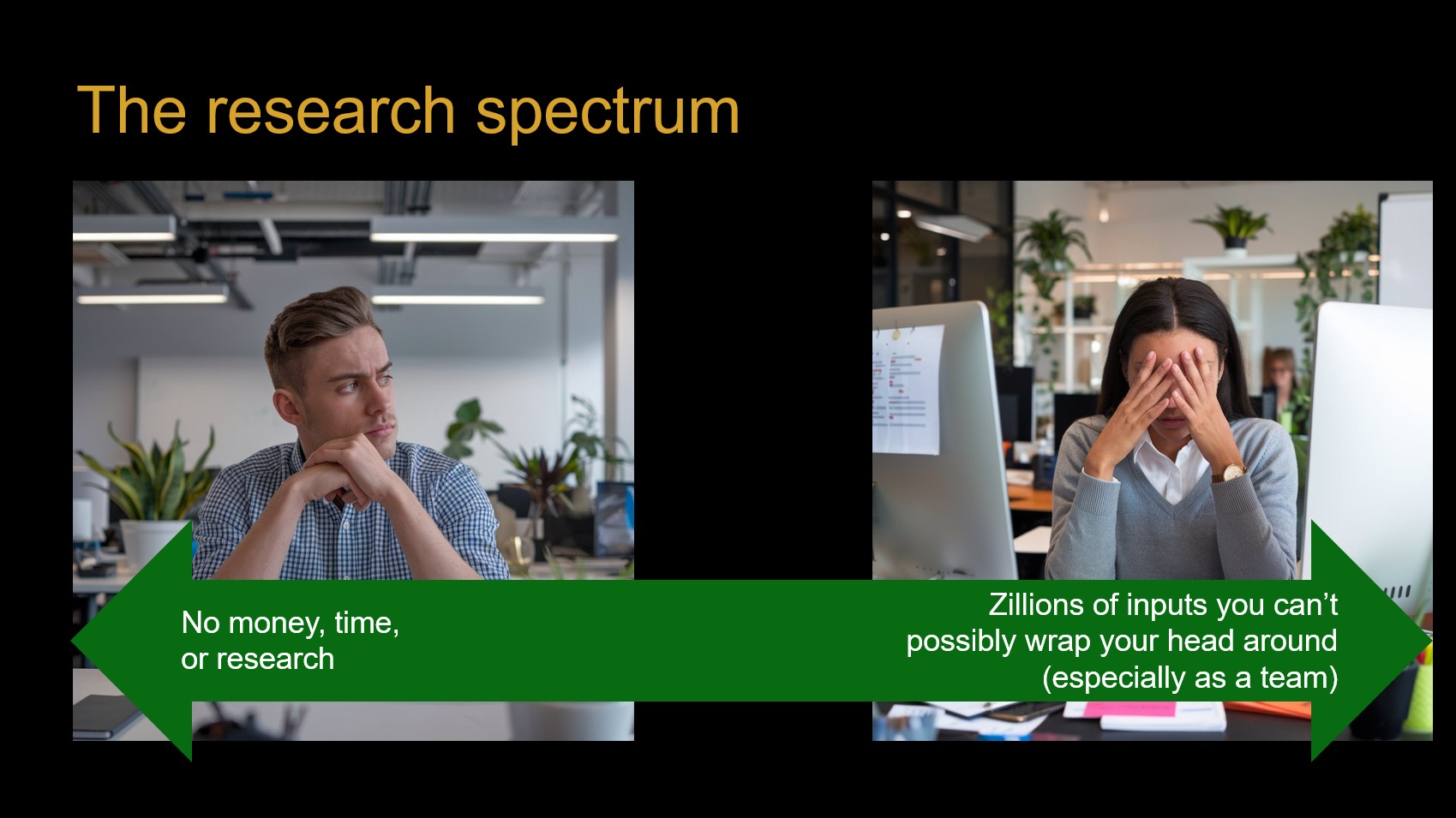
This creates a spectrum of research poverty:
- At one end, organisations have no personas, no journey maps, and no user research—teams are designing based on assumptions and internal opinions.
- At the other end, large enterprises have so much research that it becomes overwhelming and contradictory, with different departments creating their own personas that don’t align with each other and insights becoming inaccessible, or only accessible via UX custodians.
ucLoops for Design in a nutshell: democratising UX insights
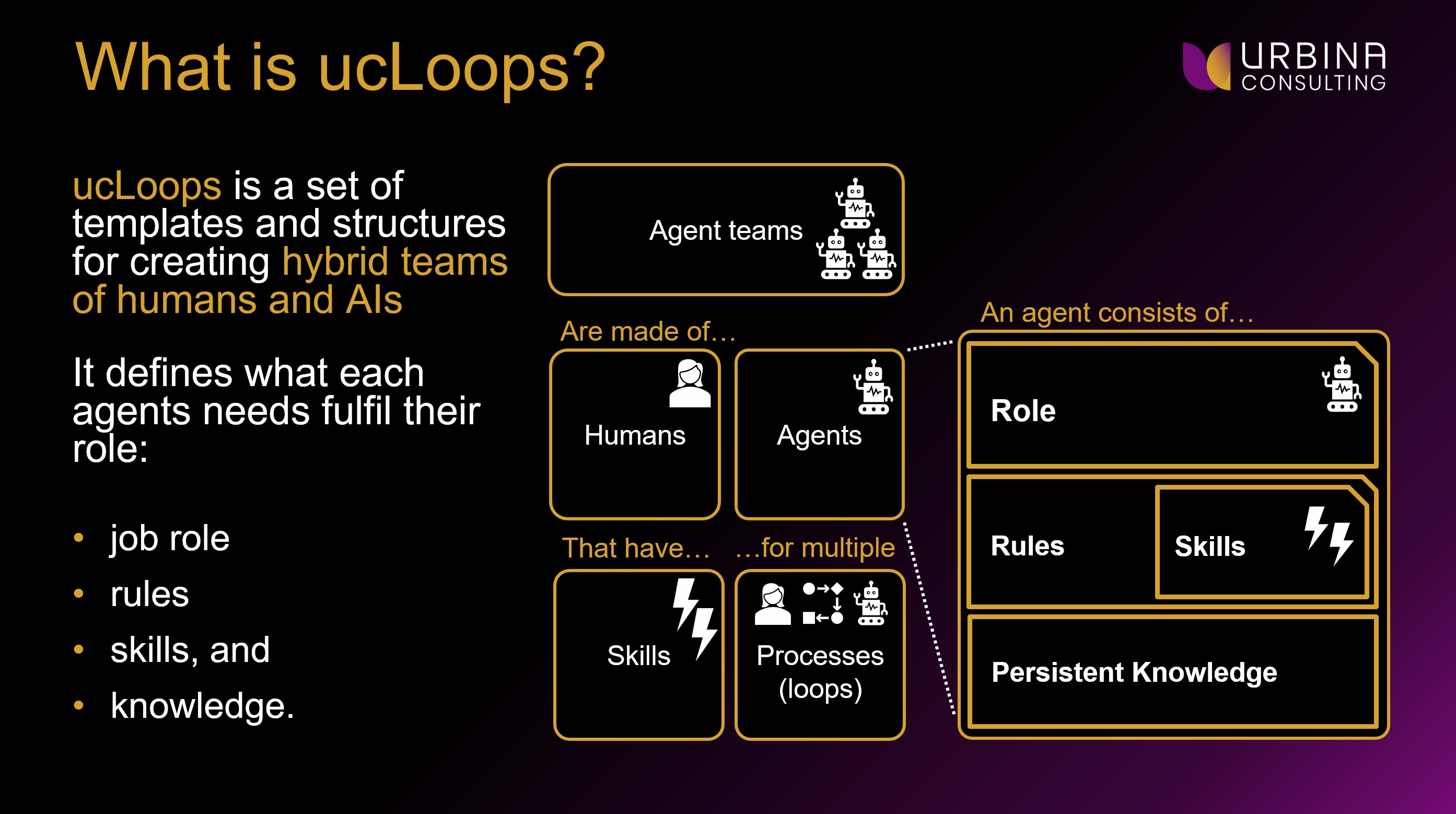
ucLoops for Design is the first implementation of the ucLoops framework.
It is not a product.
It is a repeatable, teachable framework that enables humans to work more effectively and efficiently with research assets. The design implementation is a way of configuring your existing AI tools specifically for UX and design professionals. It addresses a key research challenge by bringing existing research data to life through AI-powered persona simulations and journey-mapping acceleration.
It is an AI layer over real human research data.
The aim is to use AI for what it’s good for (synthesising data, summarising content, and enabling natural-language interaction) and to use humans for what they’re good for (everything else). It takes the personas concept and makes it interactive rather than static. Dynamic rather than rigid. All to get us to apply those personas to specific design challenges more easily. ucLoops accelerates synthesis while maintaining the rigour and human judgment that makes research valuable.
Key goals
- Ensure consistent application of UX best practices
- Maximise research ROI and democratise insights
- Enable cross-functional alignment
- Elevate the strategic impact of UX/UR on innovation and outcomes
- Extend quality UX design to traditionally underserved projects or teams
Value, not volume: the “time on task” principle
ucLoops for Design is built around the concept of “time on task”: focusing human expertise on high-value activities while using AI to handle data.
Instead of spending weeks consolidating interview transcripts into persona documents, UX professionals and the rest of the team can focus on validating insights, identifying gaps, and applying findings to solve real human problems.
We are advocating a shift in focus from using AI to replace people, or to rush to increase output, but increase the quality of the work and the process. In short: value, not volume.
The methodology amplifies the impact of existing research by making it more accessible, interactive, and applicable across different projects and team members.
Get “promoted”
The underlying concept is to promote yourself up a level on the corporate ladder to a more senior position in a hybrid team of humans and AIs.
ucLoops for Design is a methodology for accelerating audience-centric design and planning. By using generative AIs you can, for example,
- create infinitely patient personas to walk through as many Journeys as you want
- create assistant sims for specialised tasks (UX designer, draft content writer, etc.)
- create strategy assets or content plans using AI to cross-check multiple data sources.

Three phases of working with AI for design
- Data ingest and attribution takes research from multiple sources—interview transcripts, survey results, support logs, user feedback—and synthesises it into structured persona definitions and knowledge graphs. This phase handles the tedious work of data consolidation while maintaining traceability to original sources.
- Insights and ideation creates interactive persona simulations that teams can interview, walk through user journeys, and collaborate with on design challenges. These simulations are grounded in real research data but provide infinite patience for exploration and hypothesis testing.
- Action and validation helps teams evaluate design decisions from user perspectives, identify areas of uncertainty, and generate research plans that focus on the most critical unknowns. This phase also supports content generation and prototyping that’s grounded in user insights.
The human-centred philosophy: “humans are the loop”
Unlike approaches that position humans as AI supervisors (“human in the loop”) or quality checkers (“human on the loop”), ucLoops places human agency at the centre of every process.
Humans drive the strategy, make the decisions, and maintain creative control. AI provides acceleration, not replacement.

This philosophy recognises that the goal isn’t to make things faster, it’s to make them better.
ucLoops for Design builds on the underlying ucLoops methodology for AI, which intends to amplify and extend human agency and expertise by handling time-consuming, non-value-added tasks so professionals can focus on strategy, creativity, and complex problem-solving.
The hierarchy is
- Human agency
- accelerated by AI
- on top of a real-world data foundation
- that is reflective and respecting of real human experiences.
Making research accessible to nonresearchers
One of the method’s design goals is democratising access to UX insights. Not everyone who needs to understand or access personas and journey maps is trained in user research methodology.
You might be a marketer, a content professional, a specialised knowledge worker, a product manager, or even a designer who isn’t a researcher.
In any case, most design, communication, and content decisions benefit from access to the organisation’s data on audience perspective.
The tools provide a window into research findings, allowing you to apply user insights without needing deep research expertise. ucLoops extends what research expertise there is to places it typically wouldn’t reach.
This creates consistency across teams and projects. Instead of each team member interpreting research differently, ucLoops gives a shared foundation for user understanding that improves collaboration and alignment.
The “better than nothing” pragmatic approach
Could you use data straight from the AI model to replace real research? Yes.
Do we endorse or encourage that? No. But we understand.
We all have to acknowledge that in many organisations, the choice isn’t between perfect research and AI-driven research. It’s between AI-driven research and no research at all.
While we and the methodology strongly encourage grounding AI simulations in real user data, ucLoops can also serve as a “better than nothing” solution for teams that lack research budgets.
In face, even when used to create initial strawman personas or journey maps based on general market knowledge, ucLoops for Design provides a structured approach to thinking about users that’s more rigorous than pure assumption. These strawman personas can then be used to build organisational support and interest for proper user research by making the value of user insights tangible and demonstrable.
Getting skilled in these methods allows teams to quickly create compelling persona simulations and journey maps that demonstrate the power of user-centred thinking.
You can use AI to show that you need to validate what you made using AI.
Focus on quality over quantity
ucLoops embodies the principle that AI should help humans create better work, not just more work. It focuses on creating richer, more nuanced user understanding that leads to better design decisions, putting AI in its place as just another tool in the hands of an empowered human.
This represents a fundamental shift from volume-based to value-based design thinking—using AI acceleration to enable deeper user empathy and more thoughtful design decisions rather than simply producing more deliverables.
Learn more on the Rosenfeld webinar
You can watch the webinar Rapid AI-powered UX: A framework for empowering human designers for free via the Rosenverse. Note, registration is required and this webinar uses the name of ucLoops (RAUX).
Want to enable your team with AI?
AI isn’t just for journey mapping. Urbina Consulting’s AI templates, services, and methods are adaptable for many use cases, such as
- content auto-tagging
- recommendation and search systems
- omnichannel delivery, and
- personalisation at scale.
0 Comments